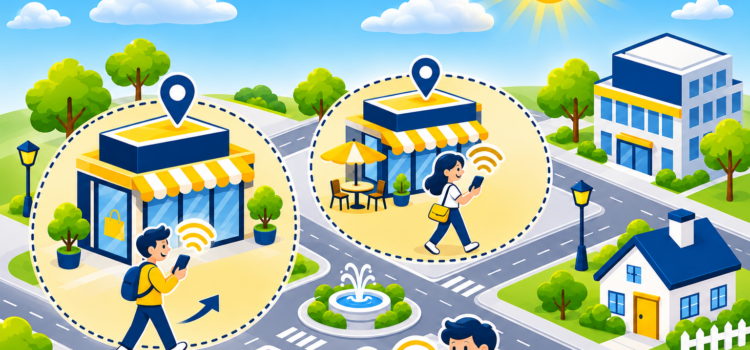
How does geofencing advertising work?
Draw a boundary. Follow a shopper.
See how location becomes an advertising opportunity.
Explore a tiny town, try different locations and leave with a practical campaign brief for your business.
What is geofencing advertising?
Geofencing advertising uses a virtual boundary around a real-world location to help define an advertising audience. Depending on the platform, eligible location signals and permissions can help identify devices associated with visits to that area. Ads may then reach eligible people through participating apps and websites, including after they leave.
Crossing a boundary does not automatically send everyone an ad, notification or text. Location eligibility, available ad placements, campaign settings and budget all affect delivery.
PLAY WITH THE POSSIBILITIES
Welcome to Opportunity Avenue.
A shop, an event, or a whole shopping district? Try a boundary and follow the story.
Illustration · not a live tracking map
OPPORTUNITY AVENUE
SIMILAR BUSINESS
THE LOCAL EVENT
YOUR BUSINESS
YOUR EXAMPLE GEOFENCE
Choose a size, or draw a rectangle with your mouse or finger. Click a building to switch locations.
This fictional town illustrates concepts. Its people, boundaries and example signals are not real audience data, estimated reach, campaign results or a map of eligible targeting locations. No location access is requested.
The animated town needs JavaScript. The full explanation and FAQs below remain available.
How a geofencing campaign works, step by step
01
Choose a relevant location
Start with where potential customers have a useful reason to be: a related trade show, a shopping area or a similar-business location. A busy place alone does not make a good audience.
02
Define the boundary and timing
Map the intended area and choose relevant dates or visitation windows. Include nearby roads or unrelated properties only when they serve the campaign’s purpose. Location precision and minimum audience requirements vary by platform.
03
Build an eligible audience
Participating technology can use eligible location signals to associate devices with visits. Permissions, data availability, platform rules and privacy requirements affect who can be included. A visit does not identify a person’s name or prove buying intent.
04
Show a useful ad
An eligible device may receive an ad when a participating placement is available. The message and landing page should match the reason for targeting that location. Delivery can occur later; it is not a guaranteed alert at the door.
05
Measure the action
Define success before launch: enquiries, bookings, sales or measured visits. Where supported, a separate conversion zone can help report later visits associated with ad exposure. An attributed visit does not prove that the ad caused a purchase.
Geofencing vs. geotargeting: what’s the difference?
Both use location. The difference is usually how the location audience is defined, although providers use the terms differently.
| Question | Geofencing | Broader geotargeting |
|---|---|---|
| What defines the area? | A boundary around a particular physical location. | Often a city, region, postal area or radius. |
| What is a typical example? | An audience associated with visits to a relevant event venue. | A campaign aimed at people in a service region. |
| When might it fit? | When a visit to a specific place is useful context. | When being within a wider market is the main requirement. |
| Does location guarantee interest? | No. Someone may work there, pass through or visit for another reason. | No. Being nearby does not establish a need. |
Where could geofencing fit your business?
▥
Retail & showrooms
Consider places where people compare products similar to yours. Connect the ad to a clear reason to visit: a range to explore, a demonstration or a relevant offer.
⌂
Home services
A home-improvement event may be more relevant than a random busy intersection. Give interested homeowners a direct next step, such as requesting an estimate.
⚑
Events & attractions
Explore audiences associated with relevant gatherings. The event dates, attendee fit and timing of your own offer matter as much as the boundary.
Smaller isn’t automatically better. Wider isn’t automatically wasteful.
A focused boundary can reduce unrelated coverage, but overly tight targeting may leave too few eligible signals. A wider district can make sense when the whole area is relevant. Choose the geography around the audience and objective, then assess real campaign data.
TAKE THE IDEA WITH YOU
Build your geofencing campaign brief.
Turn what you explored into a starting point for a conversation with Marketing Mate. Real locations and platform suitability still need review.
Your next local advertising idea.
Questions to resolve before launch
- Are these locations relevant, permitted and supported by the chosen platform?
- Is there enough eligible audience data for the campaign?
- What budget, dates and follow-up window fit the goal?
- Which offer and landing page will receive the traffic?
- How will enquiries, bookings, sales or visits be measured?
Planning brief only. No reach, cost or results are forecast. The map uses fictional places.
Your entries stay in this page until you choose to copy, download or add them to the form below. “Copy and send to Marketing Mate” fills the form’s message field for you to review. It does not submit the form.
Geofencing advertising FAQs
Can geofencing target a competitor’s customers?
A campaign may use eligible visits to a similar-business location as audience context, where the platform and its rules allow it. This does not provide a competitor’s customer list, identify every visitor or prove that someone made a purchase.
Does a geofence send an ad as soon as someone walks in?
No. Entering a boundary does not guarantee an immediate ad. Advertising depends on eligible signals, available placements, campaign rules and budget. A geofenced advertising campaign is also different from an app’s permission-based location notification.
Can people see an ad after leaving the location?
Yes, some platforms support follow-up advertising to eligible location-based audiences. The permitted audience window and delivery settings vary. Choose timing that fits the offer rather than assuming every visitor will remain reachable.
How accurate is geofencing advertising?
Accuracy varies with the location signals, surroundings, data quality and provider. A line on a map is not a guarantee that every included device was inside a particular building. Review location suitability and measurement limitations before using results to make decisions.
How much does geofencing advertising cost in Canada?
There is no single price that applies to every campaign. Geography, eligible audience size, campaign duration, ad formats, media budget, creative work and management affect the plan. Ask for an itemised proposal that separates advertising spend from service fees and defines the reporting.
Can geofencing show who visited my business?
Campaign reporting may include aggregated or modelled visit measures where supported. It should not be treated as a named visitor directory or proof of a sale. Ask how visits are defined, attributed and protected before relying on that metric.
Is geofencing available for Canadian businesses?
Marketing Mate offers geofenced advertising for Canadian businesses. Appropriate locations, audience availability, privacy requirements and platform restrictions still need to be assessed for each campaign.
YOUR NEXT STEP, RIGHT HERE
Let’s talk about your campaign.
Build your brief above and choose “Copy and send to Marketing Mate”. We’ll add the campaign details to the message below. Add your contact information, review the message, then send it when you’re ready.