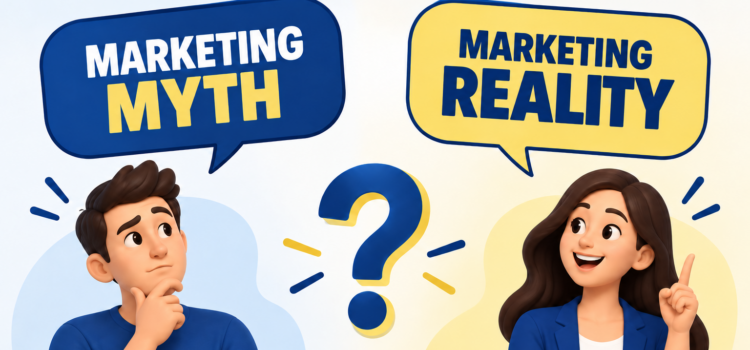
Marketing Mate · Digital Marketing Myth Challenge
Marketing Myth or Marketing Reality?
Twenty digital marketing claims. Half are myths. Half are realities. Make your pick, reveal the explanation, and see which “rules” are actually worth carrying into your website, SEO, AI search, Google Ads, social media and lead strategy.
01
No platform folklore
Separate what sounds plausible from what actually helps customers and business outcomes.
02
Current AI-search context
Built around the reality that SEO still matters while search experiences continue to evolve.
03
Useful beyond the quiz
Each answer turns the myth into a practical rule you can apply to real marketing work.
Direct Answer
What Are the Biggest Digital Marketing Myths?
The biggest digital marketing myths usually turn one useful idea into a universal rule. More traffic does not automatically create more sales. Google Ads does not buy organic rankings. Posting more often is not always better. A visually impressive website still needs clarity and conversion paths. And AI search has not made SEO obsolete.
The stronger approach is to connect audience intent, useful content, search visibility, advertising, website experience, proof, follow-up and measurement. The right question is rarely “Which tactic wins?” It is “What job should this part of the marketing system do?”
Before the Challenge
Why Marketing Myths Are So Easy to Believe
Most bad marketing advice is not invented from nothing. It usually starts with a real observation, loses the context, and gets repeated as a rule.
A metric becomes the goal
Traffic, clicks, followers and leads are useful signals. Problems start when the dashboard number replaces the business outcome the metric was supposed to help explain.
Correlation becomes causation
A business runs ads and later sees branded search rise, so someone concludes that ads improve organic rank. Two things can move together without one directly causing the other.
A tactic becomes universal
A posting schedule, page format or campaign structure works for one company and gets repeated as if every audience, market, budget and buying journey is identical.
Channels get judged in isolation
Social is expected to close the sale, SEO is expected to work instantly, and the website is treated like a brochure. Connected marketing gives each channel a more realistic job.
Interactive Article
20 Marketing Claims. Myth or Reality?
Choose before you reveal. You can answer in any order, filter by topic, and change an answer if the explanation changes your mind.
0/200 answered
Website & Conversion
“More traffic means more sales.”
What do you think?
Traffic creates opportunity. It does not create a sale by itself.
Website & Conversion
“Qualified traffic and a clear conversion path matter more than traffic volume alone.”
What do you think?
The right visit is more valuable than a random visit.
Website & Conversion
“A beautiful website automatically converts better.”
What do you think?
Good design helps, but beauty without clarity can still lose the customer.
Website & Conversion
“Dedicated landing pages can reduce friction when they match the customer’s intent.”
What do you think?
A focused destination can make the next decision easier.
Paid Advertising
“Running Google Ads improves your organic SEO rankings.”
What do you think?
Paid search and organic ranking are separate systems.
Paid Advertising
“More ad budget can scale a campaign only after the fundamentals are working.”
What do you think?
Budget amplifies the system you already have—good or bad.
Paid Advertising
“Landing-page experience matters after someone clicks a Google Ad.”
What do you think?
The ad wins the click; the page has to earn the action.
Paid Advertising
“Qualified conversions matter more than clicks when judging campaign success.”
What do you think?
Clicks are activity. Business outcomes tell you whether the activity was useful.
SEO & AI Search
“AI search makes SEO irrelevant.”
What do you think?
Search is changing, but the foundation is still search optimization.
SEO & AI Search
“You need a secret GEO or AEO hack to appear in Google’s AI search features.”
What do you think?
There is no magic file or special markup that guarantees inclusion.
SEO & AI Search
“Original expertise and useful, non-commodity content are becoming more important.”
What do you think?
Generic information is easy to reproduce; first-hand value is harder to replace.
SEO & AI Search
“Publishing more pages automatically improves SEO.”
What do you think?
Page count is not a ranking strategy.
Social & Content
“Posting every day is always better.”
What do you think?
Frequency is not a substitute for a useful content plan.
Social & Content
“Repeating a core marketing message can strengthen recognition.”
What do you think?
People do not see every post, ad, email or page the first time.
Social & Content
“Every social post should directly sell something.”
What do you think?
A feed made entirely of offers can miss the work that happens before a customer is ready to buy.
Social & Content
“Social media can influence a sale without being the final click.”
What do you think?
Customers often meet a business more than once before they enquire.
Leads & Retention
“Email marketing is outdated for small businesses.”
What do you think?
Email is still a direct channel for follow-up, retention and timely offers.
Leads & Retention
“Strong follow-up can recover opportunities that marketing alone cannot close.”
What do you think?
Generating the enquiry is only part of the job.
Leads & Retention
“The cheapest lead is always the best lead.”
What do you think?
Low cost per lead can hide poor fit.
Leads & Retention
“Different marketing channels should have different jobs.”
What do you think?
A connected system is stronger than asking one channel to do everything.
0/20
Marketing myth detector activated.
The Bigger Pattern
The Best Marketing Advice Usually Starts With “It Depends On…”
That phrase is not a dodge when the variables genuinely matter. A local service company, a national e-commerce store and a seasonal retailer should not have identical media mixes, content calendars or conversion paths.
The useful work is identifying what the business sells, who is buying, how long the decision takes, where demand already exists, what proof reduces risk, what capacity the team can handle and how a good lead becomes revenue.
- Audience: Who actually needs this?
- Intent: What are they trying to do right now?
- Offer: Why should they move forward?
- Path: What happens after the click?
- Proof: What reduces uncertainty?
- Measure: Which outcome tells us it worked?
2026 Search Reality Check
AI Search Changed the Conversation. It Did Not Delete the Fundamentals.
Google’s current guidance for generative AI features is unusually useful because it cuts through a lot of the noise: strong SEO foundations still apply, helpful and original content matters, and there is no special shortcut that guarantees visibility.
Be crawlable, indexable and understandable
Search systems cannot confidently surface content they cannot access or understand. Technical health, internal linking, clear page structure and accurate business information still matter.
Add information that is actually worth retrieving
Original expertise, useful comparisons, real examples, local knowledge, first-hand experience and clear answers give a page more value than another generic summary of common facts.
Build for the person who arrives after the answer
AI visibility is not the finish line. When someone visits the website, the page still has to explain the business, build confidence and offer a sensible next step.
Watch search visibility as the reporting evolves
Search Console now includes dedicated generative-AI visibility reporting. The measurement tools are changing too, so modern SEO should keep learning instead of declaring search “dead.”
What Actually Works
Give Every Part of Marketing a Clear Job
The strongest answer to most marketing myths is not another isolated tactic. It is a connected customer journey where each channel does something useful.
Search & Ads
Capture relevant demand and introduce the business to people with a real reason to care.
Website
Explain the offer, fit, location, process and next step without making the visitor decode the business.
Content & Proof
Use useful content, real work, reviews, expertise and consistent messaging to reduce uncertainty.
Conversion
Make the right action clear—call, form, booking, consultation, quote request or purchase.
Email & Sales Handoff
Acknowledge interest, set expectations and keep useful opportunities from disappearing after the first contact.
Measurement
Connect channels to qualified opportunities and real outcomes so the next decision gets smarter.
Keep Going
Turn the Reality Checks Into Better Marketing Decisions
Choose the next read based on the problem you actually need to solve. These guides take the ideas from the myth challenge and turn them into practical website, conversion and marketing decisions.
practical
next reads
Conversion
Best next read if traffic is coming in but enquiries are not.
Why Is My Website Getting Traffic but No Leads?
Separate a visibility problem from a conversion, message, offer or tracking problem before spending more money to attract visitors.
Website
Best next read if your homepage looks good but feels unclear.
The Anatomy of a High-Converting Small-Business Homepage
See how message, proof, customer pathways and calls-to-action work together to make a homepage easier to understand and act on.
Strategy
Best next read if your marketing channels feel disconnected.
Ottawa Small Business Digital Marketing Guide
Connect SEO, local search, advertising, website experience, reviews, email and measurement around one customer journey.
Case Study
Best next read if you want to see the connected approach in practice.
How Custom LeisureScapes Built Digital Momentum
See what happened when website, social media, search and seasonal campaigns were treated as parts of one maintained marketing system.
Quick Answers
Digital Marketing Myths FAQs
Short answers to the questions behind some of the most common marketing misconceptions.
Does more website traffic automatically mean more sales?+
No. Traffic creates more opportunities, but sales depend on audience quality, offer fit, website clarity, trust, conversion paths, follow-up and the sales process. Measure traffic beside qualified leads and revenue outcomes.
Does Google Ads improve organic SEO rankings?+
No. Google’s advertising and organic Search ranking systems are separate. Ads and SEO can support the same business goals, but buying ads does not purchase a better organic ranking.
Is SEO still relevant for AI search in 2026?+
Yes. Google says foundational SEO best practices remain relevant for AI Overviews and AI Mode. Crawlability, indexing, useful content, strong internal structure, accurate business information and original value still matter.
How often should a small business post on social media?+
There is no universal number. Choose a sustainable cadence that gives you enough room for useful, varied content. Quality, consistency, audience relevance and business capacity matter more than maintaining an arbitrary daily streak.
What should a small business measure instead of vanity metrics?+
Track the metrics closest to real business value: qualified enquiries, booked calls, estimate requests, sales, close rate, revenue, customer value and source quality. Traffic, impressions, clicks and followers still help diagnose performance, but they should not be the finish line.
What is the best digital marketing strategy for a Canadian small business?+
There is no single universal channel mix. Start with a clear website and measurement foundation, then choose SEO, local search, Google Ads, social media, email and other channels based on audience intent, geography, buying cycle, budget, capacity and growth goals.
Real Relationships. Real Results.
Ready to Replace Marketing Folklore With a Clearer Plan?
Marketing Mate helps Canadian businesses connect websites, SEO, AI-search visibility, Google Ads, social media, email and local search around the customer journey instead of chasing disconnected tactics.